Welders from Vietnam: how selection, work sample and proof of qualification work
From the requirement profile and the work sample to the welder qualification test under ISO 9606: how the selection of Vietnamese welders works.
Anyone planning to bring in welders from Vietnam wants to know one thing above all: can the candidate weld on my component, and how can I tell before the first working day? A certificate alone rarely answers that question. What matters is how the selection is structured, what a work sample shows and what scope the welder qualification test actually covers. Why certified welders are scarce and what the bottleneck costs is covered in our article on certified welders. This one is about the qualification path, step by step from your company's requirement profile to the start of the assignment. We state the framework right away, because it determines everything else. Workers from Vietnam are deployed exclusively through service, contract-for-work and subcontracting models, never through temporary staffing (German AÜG, Arbeitnehmerüberlassung). And several months pass before the assignment starts.
It starts not with the candidate but with your component. The more precise the requirement profile, the more accurate the selection. First comes the welding process, meaning MAG, TIG or stick. Then come the materials, such as unalloyed structural steel or stainless steel. Joint type and positions also matter: fillet weld or butt weld, flat position or out-of-position, plate or pipe. Add to this plate thicknesses and pipe diameters, the inspection scope of your welding supervisor and the code you manufacture to. A profile such as "TIG, stainless steel pipe, vertical up out-of-position" leads to completely different candidates than "MAG, fillet welds on structural steel in flat position". These details later also determine which test and which work sample make sense. Which metal profiles we fill overall, from fitter to machinist, is shown on our industry page on metal and metalworking.
Pre-selection runs through our own network in Vietnam, not through anonymous lists. We recruit on the ground and match candidates against your requirement profile. We review certificates, documented professional practice and the processes someone has actually worked in. A CV with the word welder on it is not enough. We ask about components, materials and positions from recent years. In doing so, we record what is proven and what is merely claimed. Those who make the shortlist have a personal interview. On request, a video interview takes place together with your company, for example with your welding supervisor, before a decision is made. This way you see early on which Vietnamese welders fit your production and where a different profile would work better.
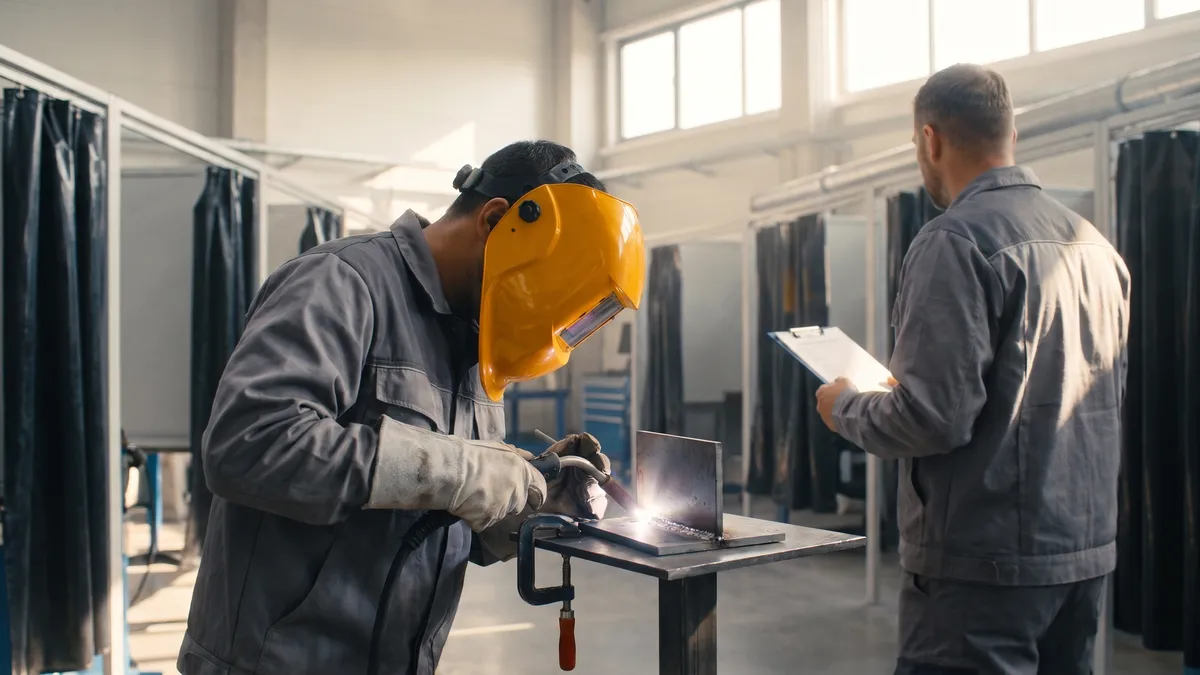
Welders from Vietnam complete a work sample on site during the selection. This is where paper and practice meet. The work sample for welders is based on your profile: same process, comparable material, matching position and joint type. The result is assessed first, meaning weld appearance, penetration, fusion and visible imperfections. The way of working counts just as much: joint preparation, setting the parameters, handling out-of-position welds and cleanliness between passes. A work sample does not replace a test to the standard, it complements it. It shows whether someone can deliver the certified qualification in everyday work. What is assessed here is the qualification as part of the selection process. It is not a guarantee of suitability for the specific assignment, and that assessment is ultimately made by your company.
The welder qualification test under DIN EN ISO 9606 is the formal proof of qualification. For steels, Part 1 applies, currently in the edition DIN EN ISO 9606-1:2017-12. The certificate confirms that a welder has produced a weld conforming to the standard under defined conditions. These conditions form the range of qualification: process, product form such as plate or pipe, joint type, material group, filler material, thickness or diameter, and position. Outside that range, the certificate says nothing. It only remains valid if the welding supervisor confirms every six months that welding has been carried out within the range of qualification. For renewal, the standard provides for a retest or test records from ongoing production. The series of standards is currently being revised, and a 2026 draft merges the previous parts. Whether a certificate holds up for your component and your code is assessed by your welding supervisor.
Besides welding, communication counts. We assess the language level as part of the selection; many candidates speak English, and we support German courses. For the start, an induction at the place of work is advisable: site, occupational safety, inspection procedures. In the contract-for-work and subcontracting model, technical instructions do not come from your company but from the contractor's own management. That is why welding procedure specifications and inspection scope belong in the contract's scope of services from the outset. A dedicated, multilingual contact person remains available to both the company and the workers. On price: certified welders start from €31.00 net per hour. This is an indicative rate, binding in the quote after the requirement analysis, depending on process, assignment duration and model.
Does the assignment run through temporary staffing? No. Temporary staffing is reserved for workers with an EU passport. Workers from Vietnam are deployed exclusively through service, contract-for-work and subcontracting models. Recruitment runs through partner structures on the ground, and Arbeitina acts as intermediary and coordinator. The employer of the workers remains the partner company in the country of origin. Responsibility for work permits and eligibility requirements lies with the partner company and with your company as the client site. Your company verifies legal eligibility to work before the first working day. How such a model is structured is explained on our page on subcontracting. We design every model so that it is clearly delimited, and we turn down anything we cannot delimit cleanly. The legal assessment in the individual case remains with your company.
How long does it take until the assignment starts at our company? Plan for several months until the assignment starts. The assignment requires valid work permits, and obtaining them in the country of origin takes this time. This part is the responsibility of the partner company in the country of origin. We do not offer visa consulting or immigration services. After the requirement analysis, we give you a realistic schedule and keep you informed about the interim steps, from selection on the ground to the first working day. More on occupational groups and the procedure is on our page on workers from Vietnam and Asia. If you are planning to bring in welders from Vietnam, describe the process, number of workers and period on our contact page. You will receive an honest assessment of profiles and schedule, and also of whether the European market covers your requirement better.
This might concern you too.
Let us talk about your staffing needs.
Outline your plan and we will recommend the model that holds up commercially and contractually.