How shipbuilding works: the process from steel plate to finished section
Design, flame cutting, section building, dock, outfitting, sea trials: how a ship is built in phases and which specialists are missing in which phase.
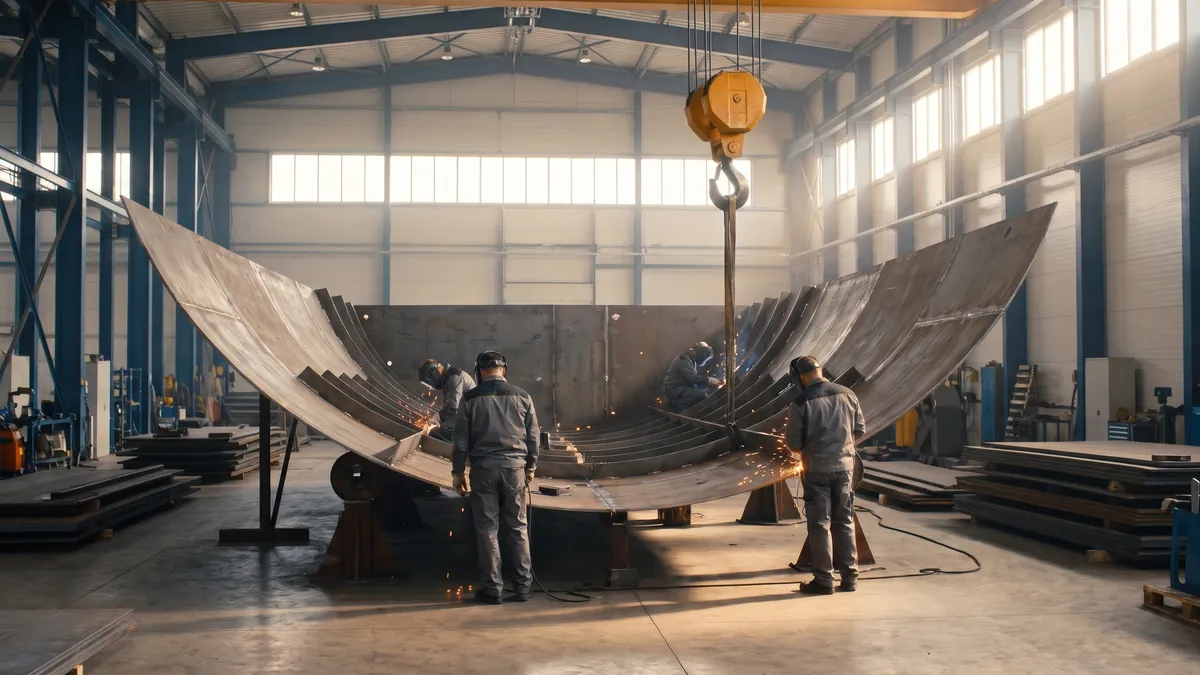
A ship is not built in one piece. It grows from a great many individual parts that are prefabricated in halls, welded into sections and only joined into the hull at a late stage. The shipbuilding process follows a clear sequence: design, steel processing, section construction, assembly in the dock or on the slipway, float-out, outfitting and trials. This article explains the phases in order, as they are customary in modern shipyards. Along the way, it shows where which specialists are needed. Anyone who understands the process also understands why a shipyard's staffing needs do not run evenly, but in waves.
It all starts with drawings and data. The design turns into detailed engineering with the lines plan, steel plan, strength calculations and the division of the hull into sections. The classification society reviews the drawings and later supervises construction. Then production planning takes over. It breaks each section down into components and creates nesting plans for the plates and cutting programs for the machines. A lot is already decided here: the more precise the production documents, the less needs adjusting in the hall later. Outfitting is planned in this phase as well. Where do pipelines and cable trays run, and which openings does the steel need? Shipyards pre-outfit sections as early as possible, because working in an open section is easier than in the closed hull later on.
In steel processing, plate becomes a component. First, plates and profiles are blasted and given a shop primer so they do not rust during construction. Then computer-controlled flame or plasma cutting machines cut the parts according to the cutting programs and mark them. Curved shell plates and frames are then formed with presses using templates. Panel and profile fabrication runs in parallel. On a panel line, plates are welded into large flat panels, turned and stiffened with longitudinal profiles. Needed here are flame cutters who operate the cutting machines and finish parts, as well as welders with experience in mechanized welding. If staff are missing at this point, everything that follows stalls.
In the shipbuilding process, section construction is the core. In a shipyard's section building, flat sections such as decks or bulkheads are first built from panels, profiles and individual parts. These become volume sections such as the double bottom, side shells or stems. Large shipyards combine several sections into blocks that already contain pipes, brackets and cable routes. The work takes place in halls under the crane, often in awkward positions and confined spaces. Shipbuilders align the components, fitters build auxiliary structures and jigs, and welders join everything in changing positions. This shows why shipyards ask about processes and positions, not just the job title. An overhead fillet weld in a cramped double bottom calls for different experience than a seam on the panel line.
Next, the sections or blocks move to the building dock or the slipway. There, the shipyard assembles them piece by piece with heavy cranes, aligns them and welds the butt joints. Once the hull is watertight and buoyant, it is floated out in the dock or launched from the slipway. That is still far from the end. At the outfitting quay, outfitting in shipbuilding continues where it already began in the sections. Pipefitters lay and connect pipelines, electricians and electrical helpers pull cables and connect distribution boards. Coating specialists take care of surface protection and painting. Then come the machinery, deck equipment and interior fit-out. The more complex the ship, the more demanding this phase becomes.
At the end come trials and delivery. First, the shipyard commissions and tests the systems at the quay. This is followed by the builder's sea trials under the shipyard's responsibility, often in the presence of the classification society. Tests cover propulsion, maneuverability, steering gear and safety systems, among other things. Only when the ship meets the construction specifications does the client take it over. For staffing needs, this means that every phase has its own profiles, and the peaks are staggered in time. In steel and section construction, the main gaps are welders, shipbuilders, flame cutters and fitters. In outfitting, pipefitters and electrical helpers are missing. Industry reports have for some time named the shortage of skilled workers as one of the bottlenecks of German shipyards.
How does a shipyard get additional staff in such peak phases? Usually through several routes at once: its own hiring, suppliers and external shipyard staff. Shipbuilding is one of the eight industries in which Arbeitina acts as intermediary and coordinator. On our industry page on shipbuilding you will find the profiles for section construction, outfitting and refit: shipbuilders, shipyard welders, pipefitters, steel fabricators, coating specialists and electrical helpers, individually or as a team. In the selection, we assess welders with a shipyard profile by processes such as MAG, TIG and stick, and by their practical experience. Because shipyard assignments are rarely close to home, we also organize accommodation and travel. Further welding and metal profiles are listed on our industry page on metal and metalworking.
Is a contract for work (Werkvertrag) suitable for work at a shipyard? Yes, when there is a clearly defined work package, such as a specific section, a pipeline segment or a coating scope. The contractor organizes itself, works without instructions from your company and is paid by result or by milestone. How this model is delimited is explained on our page on contracts for work. We design every model so that it is clearly delimited, and we turn down anything we cannot delimit cleanly. The legal assessment in the individual case remains with your company. Anyone who knows the shipbuilding process of their next project also knows the bottlenecks. Describe the phase, profiles, number of workers and period on our contact page, and you will receive an honest assessment.
This might concern you too.
Let us talk about your staffing needs.
Outline your plan and we will recommend the model that holds up commercially and contractually.